
Redesigning humanitarian financing for Kenya's Arid and Semi-Arid Lands:
The Humanitarian Outcomes Fund
Kenya's Arid and Semi-Arid Lands (ASALs) experience frequent and often predictable droughts and floods, resulting in widespread humanitarian needs. In 2023, 35% of the population was undernourished (World Bank, 2025), and humanitarian response plans received only 44% of required funding in 2021 and 73% in 2023 (UNOCHA, 2023). As a lower-middle-income country not classified as being in a protracted crisis, Kenya is likely to see further declines in humanitarian funding, despite ongoing climate-related needs.
Currently, funding often arrives too late. Service delivery begins only after a crisis has escalated, leading to worse outcomes and leaving households less prepared for future events. Local and national humanitarian actors receive just 0.6% of direct funding from the world's largest humanitarian donors (Development Initiatives, 2024). Addressing these challenges requires a new approach that pre-positions funding before predictable events, empowers local actors, and links financing to measurable results.
The Project: A Collaborative Approach to Anticipatory Humanitarian Finance
Social Finance International partnered with Oxfam Kenya to create the Humanitarian Outcomes Fund (HOF), an outcomes-based financing mechanism for humanitarian action in Kenya's ASALs, and the first outcomes fund in the humanitarian sector.
To understand the key financing challenges within the humanitarian funding ecosystem, we conducted extensive stakeholder engagement and used a Funding Diagnostic Framework to map issues around volume, funding sources, recipient structures, funding types, sectoral allocation, disbursement timing, coordination, and impact measurement.
Through this process, three core challenges emerged:
Funding is often too slow and arrives after a crisis has escalated.
Humanitarian financing is not focused on outcomes, limiting accountability and effectiveness.
Very little funding reaches local networks, reducing the capacity of those best placed to respond.
This analysis formed the foundation for the design of the HOF.
Key Elements of the Approach
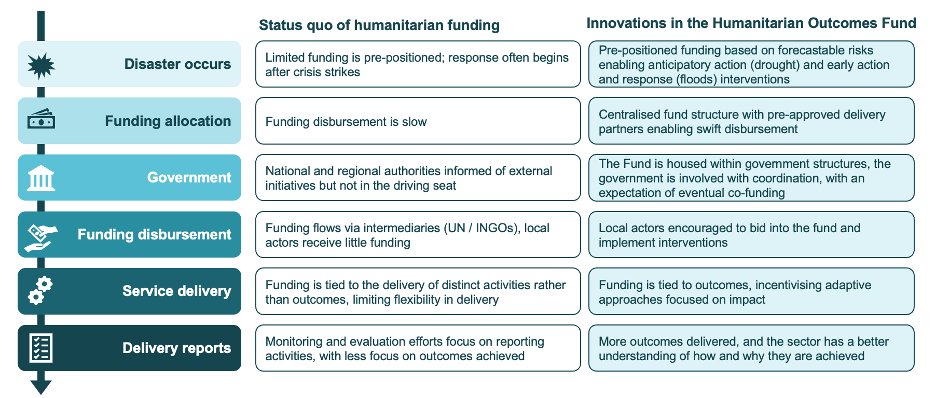
The HOF addresses three core challenges in the humanitarian sector simultaneously:
Faster, earlier responses. Pre-positioned funding is automatically triggered by early warning thresholds, and pre-qualified implementers ensure rapid disbursement during peak need. Under the HOF model, households affected by drought receive fodder and cash before humanitarian needs peak, helping families avoid negative coping strategies and maintain livestock health. For floods, households receive cash and water purification kits just before flooding, enabling them to relocate livestock and secure food and water access.
A stronger focus on outcomes. Funding is linked to outcomes instead of inputs, encouraging implementers to deliver adaptive, impact-driven solutions. Shared, standardized outcome metrics, such as the Reduced Coping Strategy Index (rCSI), Food Consumption Score, Livelihood Coping Strategy Index (LCSI), and safe water access indicators, support learning across programs and partners. Independent verification enhances transparency and accountability.
Empowering local actors. The HOF is designed to increase the flow of funding directly to local humanitarian networks, moving away from a model where resources are channeled primarily through international intermediaries. By enabling local actors to bid directly into the fund and implement interventions, the HOF builds local capacity and ensures that those closest to affected communities are resourced to respond.
The Role of Partners in Driving Impact
Oxfam Kenya plays a key role in the HOF's design and credibility. Oxfam has a strong record in innovative finance, including designing and fundraising for the Turkana Water Outcomes Fund, an outcomes-based facility for water point repair, and implementing an Index-Based Flood Insurance product in Tana River. Oxfam also supports the ASAL Humanitarian Network, a coalition of local NGOs and community groups, and has a history of collaborating with the Kenyan government on humanitarian initiatives such as the Hunger Safety Net Program.
Lessons Learned: Insights for Future Programs
Reliable early warning systems are essential for anticipatory finance. The HOF relies on Kenya's advanced drought-monitoring and flood-forecasting data to enable pre-positioned, trigger-based funding. To replicate this model elsewhere, investment in robust data infrastructure is necessary.
Outcomes-based approaches must be tailored to the context. Evidence from FCDO- funded program evaluations shows these models outperform baseline or control groups in development settings. However, designs should consider the episodic nature of crises, the need for rapid disbursement, and local actors' capacities.
Government buy-in is critical for long-term sustainability. Embedding the fund within government infrastructure and involving national authorities from the start is essential for scaling. Co-designed funds support domestic resource mobilization and improve coordination, addressing persistent fragmentation.
Looking Ahead: Scaling Impact and Future Collaborations
With the initial design complete, Social Finance International and Oxfam Kenya are currently engaging potential outcomes funders. Once funding commitments are in place, the technical design will be finalised in close collaboration with funders and the Kenyan government, ahead of mobilisation, a pilot phase, and eventual scale-up based on learnings.
As the first outcomes fund in the humanitarian sector, the HOF can serve as a global proof of concept for outcomes-based humanitarian finance. It demonstrates how pre-positioned, results-linked funding can lower the cost and impact of climate-driven crises, while empowering local actors and strengthening domestic capacity.
Interested in pioneering outcomes-based humanitarian finance? Connect with us:
📩 Chloe Eddleston, Associate Director, Social Finance International – chloe.eddleston@socialfinance.org.uk
Partners
Oxfam Kenya
Location
Kenya